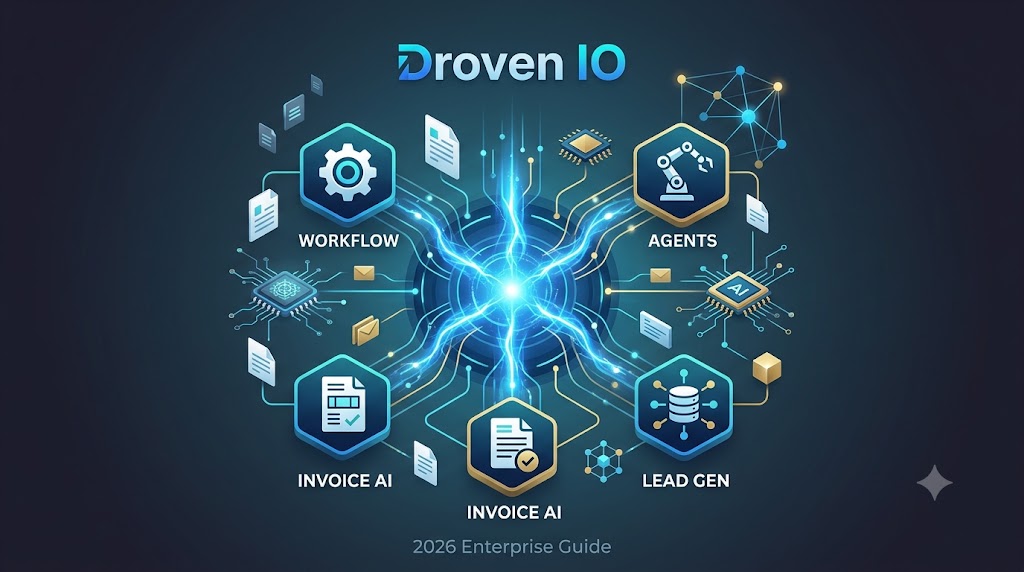
AI automation is becoming a practical way for businesses to connect apps, reduce repetitive work, and build repeatable workflows. This guide explains the main types of AI automation tools, where they fit, and what to consider before choosing one. If you are looking to audit, design, or execute advanced digital architectures, understanding the landscape of droven io ai automation tools is paramount.
Rather than working as an isolated software product, the concept surrounding droven io ai automation tools represents an overarching knowledge framework for identifying, integrating, and maintaining production-grade intelligent systems. From open-source agent runtimes to enterprise low-code systems, deploying the right execution layer determines whether your business scales or burns capital on non-performing API calls.
This definitive guide breaks down the core taxonomy of modern automation platforms, implementation strategies for deployment, and how specific industries leverage these tools for geometric growth.
What Are Droven IO AI Automation Tools?
AI automation tools can combine workflow platforms, generative AI, and AI agents to automate business processes. In this guide, we focus on practical tools and use cases rather than treating a single framework or brand as an industry standard. Instead of relying on rigid, deterministic logic (traditional “if-this-then-that” rules), these modern setups deploy Large Language Models (LLMs) alongside strict code steps to manage unstructured data.
The goal is to reduce repetitive manual work while keeping workflows understandable and reviewable. For important business processes, automated steps should still include appropriate validation, permissions, error handling, and human review. By leveraging frameworks mapped through these methodologies, operations teams can deploy autonomous agents capable of contextual decision-making across complex business operations.
Top 5 AI Automation Tools to Deploy in 2026
When structuring your corporate architecture, you must balance cost, ease of debugging, and integration depth. Here are five widely used approaches to consider. The right option depends on your integrations, technical skills, workflow complexity, budget, and need for customization:
1. n8n.io (Advanced Agent Orchestration)
n8n has emerged as a powerhouse for building modular AI systems. Unlike legacy tools that charge per individual step, its node-based infrastructure charges per full workflow execution. This makes it ideal for running loops, parsing long documents with Retrieval-Augmented Generation (RAG), and maintaining strict human-in-the-loop checkpoints before data hits production CRMs.
2. Make.com (Visual Workflow Engineering)
Make is a visual workflow platform that can be useful for multi-step automations where seeing the flow and mapping data between services is important. Its execution speed and detailed data mapping features allow developers to orchestrate multi-app ecosystems natively.
3. Zapier AI (Instant Multi-App Ecosystems)
Zapier is useful when you want a large catalog of app integrations and a relatively straightforward workflow-building experience. With its integrated AI actions, teams can convert standard API triggers into conversational prompts, enabling legacy databases to interact natively with neural network engines.
4. GoHighLevel (Local Business Engine)
GoHighLevel combines CRM features with automation and messaging tools, making it relevant for businesses that want lead capture, follow-up, booking, and customer communication in one system. It serves as the primary backbone for client onboarding, booking, and database reactivation workflows.
5. Custom LLM Pipelines (LangChain / CrewAI)
Custom Python-based workflows can provide more control over application logic and data handling, but they generally require more development and maintenance than no-code or low-code platforms. These allow complete control over data privacy, enabling localized models to execute system commands without transmitting sensitive records to external third-party servers.
The Growth of AI Automation in USA and Global Markets
The deployment footprint of these tools varies significantly by region. The surge in search queries for droven io ai automation in usa underscores a massive market reality: North American enterprises are moving away from basic chatbots and shifting toward full-scale operational overhaul.
+-------------------------------------------------------------+
|               2026 AI Enterprise Adoption Stack            |
+-------------------------------------------------------------+
|  [Orchestration Layer]    -> n8n / Make / Custom Python     |
|  [Cognitive Engine]       -> OpenAI GPT-4o / Claude 3.5     |
|  [Operational Data]       -> Live Vector DBs / Legacy SQLs  |
+-------------------------------------------------------------+
Driven by rising operational overhead and a shortage of technical personnel, US-based logistics, legal firms, and marketing groups are deploying ai workflow automation architectures to compress task execution timelines from hours to seconds. The focus has moved strictly from content generation to algorithmic data processing.
How Specific Industries Use AI Automation Workflows
To see these systems in practice, let us look at how specialized fields move from manual management to autonomous scaling:
1. Lead Generation and Contractors
Local trade industries scale outreach by combining scraped data arrays with contextual AI filters. Instead of manually cold-emailing prospects, workflows validate target contact information, run it through an intent scoring system, and craft bespoke, hyper-personalized value propositions automatically.
Context Check: If you operate a high-ticket service firm, learning the exact framework to build an AI Lead Generation Automation Painting Trade Business Workflow provides a plug-and-play architectural blueprint for scaling local outreach.
2. Financial Accounts Payable & Invoicing
Manual data entry for accounts payable is highly prone to human error. Through advanced ai invoice automation, intelligent systems utilize optical character recognition (OCR) and LLMs to instantly parse incoming multi-page PDFs, match line items against historic purchase orders, flag discrepancies, and update ERP ledgers autonomously.
3. Hospitality Operations and Financial Integrity
Modern service environments process vast amounts of unstructured financial data daily. Point-of-Sale (POS) systems can be unified with internal tracking models to manage complex payroll elements. For instance, discovering how to Automate Tip Calculation and Distribution for Restaurant Staff highlights how deterministic code blocks and automated reporting can completely safeguard operational margins.
4. Industrial IoT and Hardware Communication
Advanced automation is not limited to cloud software. Physical industrial settings bridge hardware metrics with central control dashboards using specific protocols. Implementing edge-computed automation—such as knowing how to Connect Pi4 Modbus to Mango Automation—allows teams to extract register data from physical assets and feed it directly into cloud-based predictive maintenance models.
6 Steps to Deploy a Production-Grade AI Automation Framework
If you are scaling an internal team or launching a dedicated ai automation agency, following a standardized deployment framework prevents system drift and API failures:
- Process Audit & Bottleneck Analysis: Map the exact data inputs, manual checkpoints, and software dependencies of your target workflow. Never automate an inherently broken process.
- Tool Chain Selection: Choose your execution environment based on logic complexity. Use n8n or custom code for heavy looping/data parsing; use Make or Zapier for straightforward API webhooks.
- Data Grounding & Vector Storage: If your workflow requires contextual reference (such as internal training PDFs or historic tickets), structure a reliable RAG pipeline using Vector databases.
- Logic Isolation & Guardrails: Constrain your AI nodes with explicit rule-based boundaries. Ensure malicious inputs are filtered early and sanitized before reaching downstream databases.
- Human-in-the-Loop Intercepts: For critical paths—such as client-facing communications or financial payouts—insert strict approval gates where a team member must verify the output before final routing.
- Telemetry & Observability Instrumentation: Connect your automation paths to monitoring tools. Track execution status, success rates, token usage latency, and cost-per-interaction from day one.
   [Incoming Webhook] ---> [Deterministic Input Validation]
                                    |
                                    v
     [Human Gate] <--- [AI Processing Node / RAG Context]
          |
          v
   [Downstream CRM / Database Write]
FAQs: Mastering AI Automation Tools
What is the primary difference between AI and regular automation?
Traditional automation runs on hardcoded, binary rules (e.g., if column A is empty, send Email B). It cannot handle unexpected data variations. AI workflow automation integrates machine learning models, allowing the system to comprehend unstructured data, understand intent, categorize tone, and make context-aware decisions within a structured workflow.
Why do many AI automation agency models fail during delivery?
Most agencies fail because they prioritize superficial brand recognition over technical system architecture. They build fragile connections that break under edge-case data scenarios, omit human-in-the-loop checkpoints, and fail to configure system telemetry to monitor API consumption and model drift.
How secure are automated workflows built on platforms like n8n or Make?
Security depends entirely on your deployment method. Cloud platforms offer robust encryption protocols and SOC2 compliance. However, for highly sensitive sectors handling proprietary financial or personal identity records, self-hosting open-source tools like n8n behind private firewalls provides absolute control over data processing boundaries.
How does token usage impact the cost of running long-tail automations?
Unlike static SaaS applications with fixed monthly fees, running deep AI automations incurs variable execution costs based on inputs and model outputs. To keep processing cost-efficient, utilize lightweight models (such as GPT-4o-mini) for basic text sorting and classification, reserving larger, complex models exclusively for tasks requiring deep reasoning.
Next Steps for Your Automation Architecture
Deploying modern automation platforms transitions your operations from a position of reactive manual labor to one of predictive execution. Whether your goal is optimizing local B2B customer pipelines, securing enterprise infrastructure, or configuring complex cloud ledger systems, success requires choosing the precise architecture for the task.
Begin by identifying the single highest-volume, highest-friction manual process in your daily operations, select a reliable orchestration layer, and build a sandbox environment to test your logic variables under real data conditions.